Education in the UAE
Over the past decade the United Arab Emirates has, to the surprise of many, become a serious educational hub. More than a hundred higher education institutions operate here, but it is worth knowing that 54 hold state accreditation. About three dozen of these are branches of Western universities, from New York and Manchester to the Sorbonne. International students already make up 35 percent of those at private universities in Dubai, and the country hands out generous scholarships in artificial intelligence, engineering and business.
But, like any road to hotter climes, the path from Kyrgyzstan to the UAE is not strewn with rose petals. Studying here demands a budget that will give many a mild fright. Annual tuition easily tops 40 thousand dirhams, and with accommodation the total climbs to a full 100 thousand. You will also have to adjust to local laws and a mentality in which a foreigner is a guest, obliged to respect the culture of an Islamic state. On the plus side, there is no need to learn Arabic at all, and employers are no less impressed by a New York University degree earned in the middle of the desert.

The good and the not so good
Let’s start with the upsides. Safety here is exceptionally high — and that is not just a slogan, the UAE really is peaceful. What is more, 90 percent of the population are expats from two hundred countries, so foreigners are treated with tolerance. The state invests in education systematically: Dubai, for instance, has set itself the goal of raising the share of international students to fifty percent by 2033. Income is not taxed, and after graduation the best students can obtain a «Golden Visa» — as much as ten years of residency.
The downsides, frankly, carry weight. For the average Kyrgyz citizen the cost of study is very high, and a discount is hard to come by. State scholarships are mostly reserved for UAE citizens — it is their taxpayers’ money, so nothing personal. Social life is tightly regulated: alcohol in public is banned and the dress code is conservative. And from November to March the heat still reaches plus forty, which limits daytime activity — going outside at midday is quite an ordeal.
The programmes on offer
Summer camps and language schools are perhaps the safest option for a first trip. The campuses sit in secure areas, often on the grounds of universities such as Heriot-Watt, and the programmes combine English with excursions. Two-week courses for children aged 12–18 with accommodation in a four-star hotel cost around 2,900 dollars, while the most budget-friendly options start from 748 dollars a week. Language schools take adults from the age of eighteen, usually with weekly intakes.
The UAE’s main draw is the branches of foreign universities — almost forty of them operate in Dubai. Dubai International Academic City (DIAC) brings together 21 campuses, the world’s largest cluster of foreign university branches. Study at the University of Birmingham in Dubai and you earn a United Kingdom degree without leaving the Middle East. Popular choices include University of Birmingham Dubai (80th in QS) and Heriot-Watt (256th), along with the Australian Murdoch and Wollongong. Local universities are strong too: Khalifa University (202nd) is among the region’s best in engineering and the sciences.
Bachelor’s and Master’s programmes are taught in English or Arabic. You will need a secondary school certificate (twelve years), a language certificate (IELTS 6.0 minimum) and sometimes internal exams. Costs vary widely: engineering at Khalifa University is around 75 thousand dirhams a year, the American University of Dubai up to 155 thousand, and an MBA can run to 120 thousand and more. But the UAE is a regional hub, home to the offices of every global giant, so the investment can pay off.
Student life
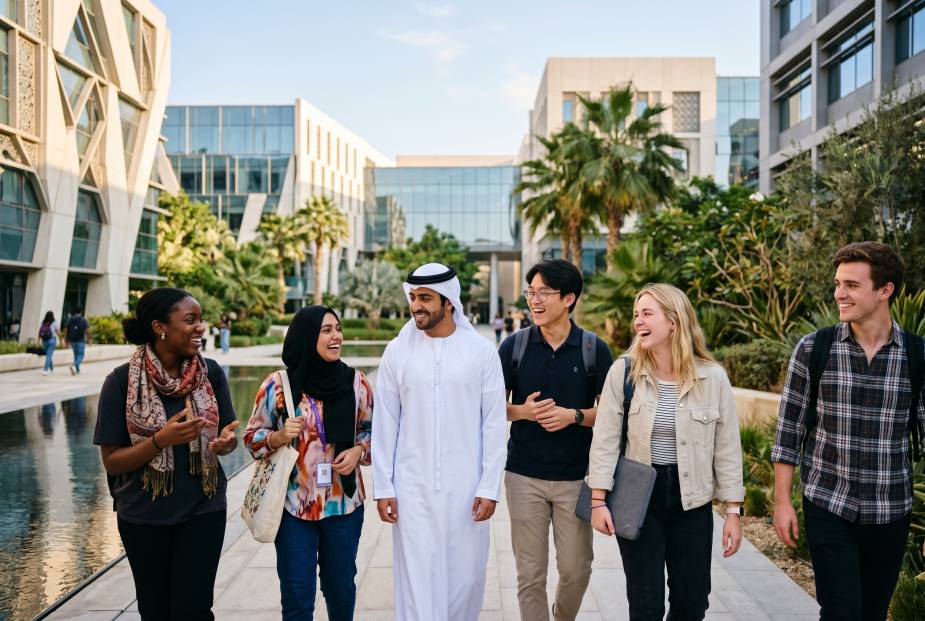
Life is expensive — there is no getting round it. Student residences cost from 3 to 7 thousand dirhams a month depending on how smart they are. A cheaper option is to share a rented room off campus: from one and a half to 3,800 dirhams. Some universities settle the housing question for you: NYU Abu Dhabi requires on-campus accommodation for all four years, while Khalifa University charges 18–30 thousand a year. Don’t forget to budget 300–700 dirhams for utilities.
Food is cheapest at chains such as Carrefour and Lulu, while a meal out costs from 30 dirhams. For transport, a Nol card is essential in Dubai (about 4 dirhams a trip), buses run between the emirates, and the E1 bus connects Abu Dhabi with the city of Al Ain.
The one thing you cannot do without in daily life is air conditioning — you simply will not get through the summer otherwise. Be ready, too, for strict laws: public displays of affection or drinking alcohol in unauthorised places can lead to deportation. And one more important point: communication here happens mainly through messengers — WhatsApp, Telegram, Instagram. Visa appointments and housing are arranged online, so be ready to type a lot and fast.
Unique features
In the UAE, artificial intelligence became a compulsory school subject in 2025. Children study algorithms, the ethics of using technology, and learn to tell a human from a machine. These are not the computer-science lessons of the nineties.
Western degrees without leaving the country are a reality. The branch of the University of Birmingham mirrors the home university’s programme exactly, right down to graduation ceremonies in the United Kingdom. You may never once set foot in England, yet earn precisely the same degree.
A «Golden Visa» for top students. From 2026 the Golden Visa Scholarship Track was introduced: the best students automatically receive a ten-year residence permit after graduation. That is a serious trump card.
MBZUAI in Masdar City deserves a special mention — a specialist artificial intelligence university (Mohamed bin Zayed University of Artificial Intelligence). Tuition there is free, with generous scholarships for Master’s and PhD students.

What matters for citizens of Kyrgyzstan
Our countries have signed agreements on cooperation in education, including a memorandum of understanding and an agreement on quotas for state-funded study at Bachelor’s and Master’s level. More than a hundred Kyrgyz students are already studying in the UAE. That said, the specific mechanisms for awarding scholarships through the embassy or development funds need clarifying on the ground — don’t hesitate to contact the UAE Embassy in Kyrgyzstan, where they will help.
A separate word about the «El Umutu» programme (2026, decree No. 176), which supports talented young people from Kyrgyzstan studying in Master’s and doctoral programmes abroad. If your university is in the QS top 100 and your academic results are excellent, you can apply for this scholarship. Graduates of the programme join the civil service personnel reserve without competition — a serious advantage in itself.
Our countries are also planning to deepen cooperation, with the opening of joint universities and centres of Arab culture in Kyrgyzstan currently under discussion.
The key points in brief
The UAE offers not just study, but access to world-class education without long flights or adjusting to a Western mentality. Here a student lives in complete safety, breathes a multicultural atmosphere, studies in English, and after graduation has the chance to stay in one of the wealthiest regions in the world. The price for this is a high cost of living and the need to respect local laws. Even so, the chance of a full grant for tuition and accommodation at universities such as NYUAD or Al Qasimia University, together with budget quotas under intergovernmental agreements, makes this expensive country a real option for ambitious Kyrgyz citizens.
If you still have questions about choosing a university in the UAE, arranging a scholarship or preparing documents, get in touch with our specialists. We will help you choose the best route and make enrolling in the Emirates as transparent and predictable as possible.