Education in Germany
Germany has long been one of the biggest draws for students from around the world. According to the DAAD, more than 420,000 international students are enrolled there in the 2025/26 academic year — a new record. And it is easy to see why. You can genuinely earn a world-class degree while paying next to nothing in tuition fees. Sounds too good to be true? Not quite. But this dream comes at a price — your patience, your time and a willingness to plunge headlong into German bureaucracy.

The upsides and the sticking points
Let us start with what attracts everyone — free or almost free tuition. Most state universities in Germany charge no tuition fees as such. You pay only a semester contribution of 100 to 400 euros, and that often includes a travel pass covering all public transport in the region. There is one exception: the federal state of Baden-Württemberg charges international students 1500 euros per semester. Private universities are another matter, with fees running from 5,000 to 20,000 euros a year. But on the whole — yes, almost free.
The second major plus is the close link between academia and industry. German education, especially at universities of applied sciences and in the dual system, prepares you not for abstract exams but for real work. The third advantage: you have 18 months to find a job after graduation. That is very generous, leaving you time to look around at your own pace.
Now for the drawbacks. Life in Germany grows more expensive every year. For your visa you must deposit 11,904 euros into a blocked account (Sperrkonto) — the sum the authorities reckon you need for a year of living costs. In the larger cities the reality is dearer still. A room in a student hall costs 200–400 euros but is hard to come by; private accommodation starts at 600. In Munich the average room reaches 750 euros.
Bureaucracy is a pain all of its own. Registering your address, obtaining a tax number, opening a bank account — your first weeks in Germany become a quest. Every official keeps their own hours, documents arrive by ordinary post, and you wait.
The programmes on offer
For school pupils and students who first want to polish their German, there are language courses and summer camps — a gentle way in. Set aside roughly 5,000–8,000 euros for a year of intensive classes.
Secondary education at private schools is, for international students, practically the only route to the German Abitur school-leaving certificate, since state schools as a rule do not take foreigners. Fees run from 15,000 to 40,000 euros a year. Not cheap, but the path to German universities then lies open.
The Bachelor’s is the main route. The vast majority of programmes are taught in German, though English-taught options exist. For admission you must either have completed at least one year of university at home or attend a one-year preparatory college, the Studienkolleg. As for language, the Studienkolleg requires German at no lower than B1, while direct admission to a university usually calls for C1.
The Master’s is especially attractive to our graduates, with a wide choice of English-taught programmes. You can also win a DAAD scholarship — 992 euros a month plus supplements — which helps a great deal.
Dual education (Ausbildung) is a uniquely German feature: you study and work at a company at the same time, learning the theory at a university or vocational school and the practice on the job. Such graduates are snapped up by employers before they even receive their diploma.
And there is the MBA for those aiming high. Fees reach 65,000 euros, but the return is to match.

What student life is really like
The first weeks after arrival are a bureaucratic ordeal you simply have to get through: registration with the local authority (Anmeldung), a bank account, insurance — and without that registration, incidentally, the blocked account cannot be unlocked. All of this must be sorted before you settle down to study.
Finding somewhere to live is the biggest everyday challenge. In the popular cities — Munich, Berlin, Hamburg, Cologne — competition for every room is fierce, with prices nearing 600–650 euros. Universities rarely provide halls, so students search on their own through social-media groups or WG-Gesucht.
Public transport is excellent but pricey. That said, the semester ticket (Semesterticket) included in your contribution covers travel across the whole region in many federal states — a serious saving.
Germans are reserved and courteous, and at first their reserve can feel like coldness. You soon get used to it, especially once you make friends among other international students — people come to study in Germany from all over the world.
What you will not find anywhere else
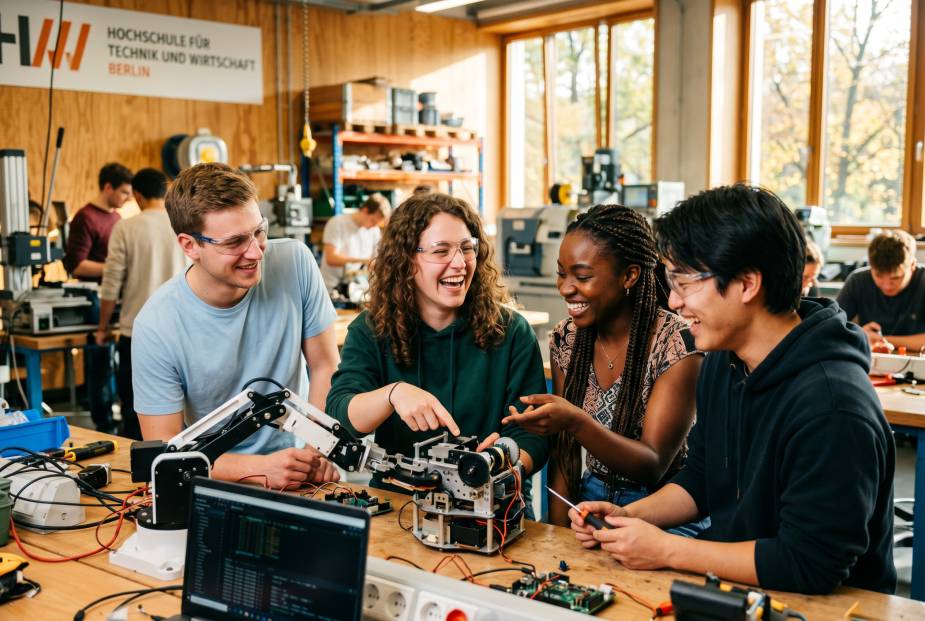
The dual education system — worth repeating. In Germany you can train for a profession without ever entering university, through dual training. This hybrid of study and work produces highly qualified mid-level specialists: car mechanics, IT professionals, nurses. It is a respected path to stable work with a good salary.
Then there are the practice-oriented universities (Fachhochschulen). Unlike classic universities, the emphasis here is firmly on practice: lecturers often work in industry, and students undertake long internships.
And the strong research centres. The Max Planck, Fraunhofer and Leibniz associations work closely with universities. As a PhD student you can be based at one of these institutes and paid as a full member of staff.
What matters most for young people from Kyrgyzstan
For us the chief barrier is the German language. The Ambassador of Kyrgyzstan to Germany put it plainly: «To go to this country, it is enough to know the German language». The trouble is that German has been dropped from our school curriculum, so you will have to catch up on your own or in classes.
Your main ally in finding funding is DAAD Kyrgyzstan in Bishkek. It awards scholarships to Master’s and doctoral students (992–1400 euros a month plus supplements) and offers free admission consultations.
Dual training programmes (Ausbildung) are open to international students, including citizens of Kyrgyzstan. They usually require German at B1 level and a training contract with a German company. For up-to-date information, your best course is to contact the German embassy in Kyrgyzstan or an official representative.
Kyrgyz graduates of German universities have 18 months after graduation to find work in their field. The job market is crying out for IT specialists, engineers and medical staff. Employers value German qualifications and are glad to help with work visas.
The bottom line
Germany offers the chance of a quality education for next to nothing, but it demands discipline, persistence and a willingness to break through bureaucratic walls. If you are ready to learn German, get to grips with the paperwork and hunt for housing in a fiercely competitive market, a German degree will be your ticket to a strong career. If you still have questions — choosing a programme, preparing for the Studienkolleg, the DAAD scholarship or the documents — come and talk to us. We will help you map out the route without the unnecessary stress.