
Australian Student Visa: GS Requirements, Finances and the Path from Study to Work
Australia has reshaped its student visa system considerably in recent years. The headline changes: the GTE (Genuine Temporary Entrant) declaration has given way to the structured GS (Genuine Student) questionnaire, the financial threshold has risen to 29,710 Australian dollars a year, the language bar has been lifted to IELTS 6.0, and the cap on working hours has returned to 48 per fortnight. The system is stricter but also more transparent. For anyone ready to evidence their study intent, Australia remains one of the most attractive destinations, with generous post-study opportunities.

The Visa Type and Who It Suits
Subclass 500 (Student visa) is the single visa for all international students enrolling in full-time programmes of any length: from language courses and vocational study (colleges) to Bachelor's, Master's and PhD. Short courses of up to 90 days can be taken on a tourist visa, but proper study requires the Subclass 500, submitted online through the ImmiAccount portal. You can apply from Kyrgyzstan, without leaving the country. The visa's validity is tied to the length of your programme (up to a maximum of five years).
The Main Filter: GS Instead of GTE
On 23 March 2024 Australia replaced the GTE (Genuine Temporary Entrant) essay with the new GS (Genuine Student) standard. The emphasis has shifted: previously you had to prove that you were here only temporarily and would definitely leave; now it is enough to show that you are coming specifically to study, rather than to work or immigrate under the guise of being a student. Formally, it is five set questions on the form, each answer no longer than 150 words. In essence, it is your academic and career logic: why you chose this particular field and this university, how it builds on your previous education, and what you intend to do with the degree afterwards.
One point to note: citizens of certain countries (the list covers a number of states) must apply through an accredited agent and complete an additional GS Stage 2 form, a CV and a detailed personal statement. Kyrgyzstan is not currently on this list, but you should confirm the latest requirements with the embassy before applying.
Financial Requirements
Australia has raised the minimum threshold of confirmed funds from 24,505 to 29,710 Australian dollars a year (roughly 17,500–18,000 US dollars, depending on the exchange rate). You must show this sum on top of the cost of your first year of tuition (as stated in the Confirmation of Enrolment). The official rules set no strict holding period for the funds, but in practice the immigration service expects the money to have been in the account for at least three months and to have a clear origin; a large sum deposited shortly before applying will raise questions. Statements from a personal account, a parent's account (proof of relationship required) or a scholarship letter are accepted.
Our recommendation: keep a comfortable buffer of 35,000–40,000 Australian dollars in the account to make a convincing case, especially if your university falls into the high-risk category.

English Language
Since July 2024 the minimum IELTS threshold for the Subclass 500 has risen from 5.5 to 6.0 (no lower than 5.5 in each component). PTE Academic (minimum 50) and TOEFL iBT are also accepted. Online and at-home test versions are not. If you are enrolling in medical, legal, teaching or nursing programmes, the threshold may be higher — IELTS 7.0–7.5. Some universities offer conditional admission followed by language courses, so check with the specific institution.
Health and Insurance
Overseas Student Health Cover (OSHC) is mandatory for every applicant. The policy must be issued by an Australian provider approved by the Department of Health, and it must cover your entire stay from the date of arrival. The cost is around 500–700 Australian dollars a year. Without valid OSHC the embassy will not issue the visa, and going without it in Australia breaches visa condition 8501.
In some cases — for stays longer than six months or for those enrolling at medical institutions — an additional examination by a doctor accredited in Australia may be required.
The Application Process for Citizens of Kyrgyzstan
Australia has no embassy in Kyrgyzstan; visa matters are handled by the Australian Embassy in Almaty (Kazakhstan). Applications are submitted online through ImmiAccount, and biometrics (fingerprints) are given at an authorised Australian visa centre; the one nearest to Kyrgyzstan is in Almaty.
Step by step:
-
Obtain an unconditional offer from an Australian university (Letter of Offer).
-
Accept the offer, pay the deposit (usually part of the annual cost) and receive the Confirmation of Enrolment (CoE).
-
Submit the application online through ImmiAccount, attaching the CoE, passport, financial documents, OSHC and language certificate.
-
Answer the five GS questions on the form clearly, avoiding generic phrasing.
-
Pay the fee — around 1,600 Australian dollars for 2026.
-
If the embassy requires it, undergo a medical examination and provide biometrics.
-
Wait for a decision — from 4 to 12 weeks.
-
Key documents: passport, CoE, a three-month bank statement, OSHC, IELTS/PTE, school certificate or diploma with translation, and birth certificate.
Working While You Study
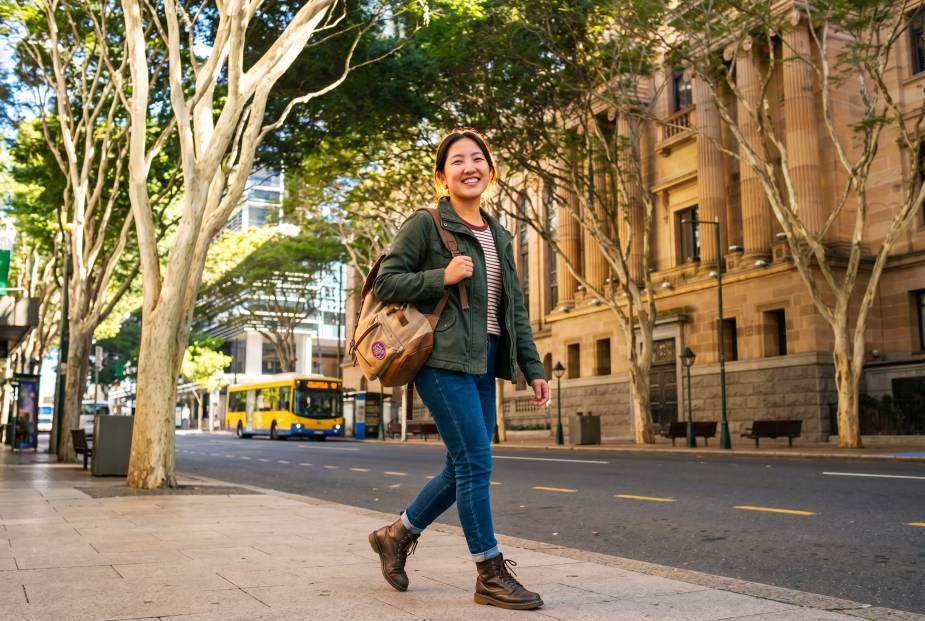
Since July 2023 the limit has been 48 hours per fortnight during term and unlimited during the holidays. Research Master's and PhD students are exempt from the cap. One important rule: you may only start work once classes have begun. Exceeding the limit directly breaches your visa conditions and risks cancellation.
After Graduation: Temporary Graduate visa (Subclass 485)
Australia's main draw is the Temporary Graduate visa (Subclass 485). Bachelor's, Master's and PhD graduates can secure from 2 to 5 years of legal work in Australia, depending on their level of education and field.
The basic conditions:
-
Completion of at least two years of full-time study.
-
Applying within six months of receiving the diploma.
-
Aged under 35 (research Master's students and PhD candidates may apply up to the age of 50).
On the Subclass 485 you can work full-time without restrictions and change employers and professions freely. It is a direct route to experience and, in turn, to permanent residence through skilled migration (the general points system) or employer sponsorship.

Pitfalls and Realities
GS is no formality. Visa refusals are most often down to the five answers being judged unconvincing, so specifics and a logical thread linking your past, present and future are vital.
Financial history. A large sum deposited into the account a month before applying is a red flag. The funds must have a clear origin, and although no fixed period is set, it is best for them to have been in the account for at least three months.
Application timing. You can apply once you have your CoE; the visa window opens 124 days before the course start date. Aim to submit at least 2–3 months before the date stated in the CoE, leaving time for the medical examination (up to four weeks) and ImmiAccount processing. Do not start work before your visa is officially confirmed and classes have begun — this, too, breaches your conditions.
What Matters for Applicants from Kyrgyzstan
The Australian Embassy in Almaty handles visa matters for citizens of Kyrgyzstan. All applications are submitted online and biometrics are given in Almaty, so plan your trip to Kazakhstan in advance. Bear in mind that Kyrgyzstan falls into the category of countries whose financial documentation faces heightened scrutiny. We recommend preparing your statements with the utmost care: translate them into English, have them notarised and ensure the funds have a clear origin.
Conclusion
The Australian student visa is a modern system — stricter than before, but with clear criteria. The main requirements: funds of at least 29,710 Australian dollars a year (with a clear history), IELTS 6.0, answers to the five GS questions with transparent logic, and mandatory OSHC. The upsides are working up to 48 hours per fortnight and the post-study Subclass 485 visa for up to three years. The downsides are the long processing times (up to 12 weeks) and the need to travel to Almaty for biometrics. With careful document preparation and a convincing case for your study purpose, the visa is well within reach, and the post-study opportunities make Australia one of the best options for long-term career planning.
If you still have questions about choosing an Australian university, preparing your GS answers or putting together your financial documents, get in touch with our specialists. We will help you build a strong application, minimise the risk of refusal and complete the path to an Australian degree without unnecessary delays.