Education in France
France is far more than cheese and the Eiffel Tower. Here a high standard of education genuinely goes hand in hand with a way of life that many fall for in their very first term. For us Kyrgyzstanis, the country was long one of the most affordable in Europe. But 2026 changed all that, and choosing France now means keeping the calculator close at hand. Let us work out, calmly, where things stand.
The good and the not-so-good
Let us start with the news that cannot be glossed over. From the 2026/2027 academic year, France has raised tuition fees for students from outside the EU. A Bachelor’s used to cost 178 euros a year and a Master’s 254. The figures now are 2,895 euros for a Bachelor’s and 3,939 for a Master’s. The jump is steep. Even so, a French education remains markedly cheaper than in the USA or the UK, and the quality stays high: 48 French universities feature in the world rankings, and in mathematics, luxury, aerospace and AI the country is still among the leaders.
There are drawbacks, of course. Life in Paris and the other big cities is expensive. And there is a further blow: from 1 July 2026, international students from outside the EU may lose their entitlement to APL housing assistance unless they hold a social scholarship. APL once covered part of the rent for almost everyone — no longer. With the new fees, the total annual budget in Paris can easily reach 15,000–20,000 euros. That is the reality.
The programmes on offer
Begin with the gentle way in — summer camps and language schools, ideal for a first taste. A four-week summer school at the University of Pau, for instance, costs 950 euros, while teenagers aged 12 and over can join two-week programmes with a family stay from 1,680 euros. It is a good way to test the waters.
Secondary education in France is offered at both state and private boarding schools. Fees vary widely: from 3,500 to 8,500 euros a year at schools under contract with the state, and from 26,000 to 40,000 at elite private boarding schools. Expensive, especially for our families, but in return the child earns the French Baccalauréat and a place at the country’s best universities without further entrance exams.
Bachelor’s and Master’s degrees are the main route. Under the new rules a Bachelor’s for non-Europeans costs 2,895 euros a year and a Master’s 3,939. There is an important nuance, though: universities may exempt up to 30 percent of international students from the increase, particularly those on exchange or holding a scholarship. So there is hope.
The Grandes Écoles are another story altogether — the pinnacle of the craft. Unlike ordinary universities, which you can enter with almost any school certificate, they are elite institutions with fierce competition. There are around 230 in all, but only a few dozen are truly prestigious: HEC Paris, ESSEC, ESCP, Sciences Po. They produce presidents, senior managers and corporate leaders. Getting in as a foreigner is hard, but realistic with deliberate preparation.
The MBA. France ranks among the world’s top three for business education, home to two schools in the global top 10 according to QS 2026: HEC Paris (fifth) and INSEAD (eighth). The cost bites: the full MBA at HEC Paris is about 78,000 euros and at INSEAD close to 100,000. But the return is to match: 94 percent of HEC graduates find work within three months, with a median salary of 96,000 euros a year.
What student life is like
Choose Paris and you must be ready to spend on housing. A room in a CROUS hall runs 300–600 euros a month, private accommodation from 800 to 1,500. Outside Paris — in Lyon, Toulouse or Montpellier — life is cheaper: CROUS at 200–400 euros and a total monthly budget of 900–1,300 euros.
A piece of good news: from 4 May 2026 a single rate for meals in university canteens was introduced — just 1 euro for a full lunch for all students, international ones included. That eases the wallet considerably.
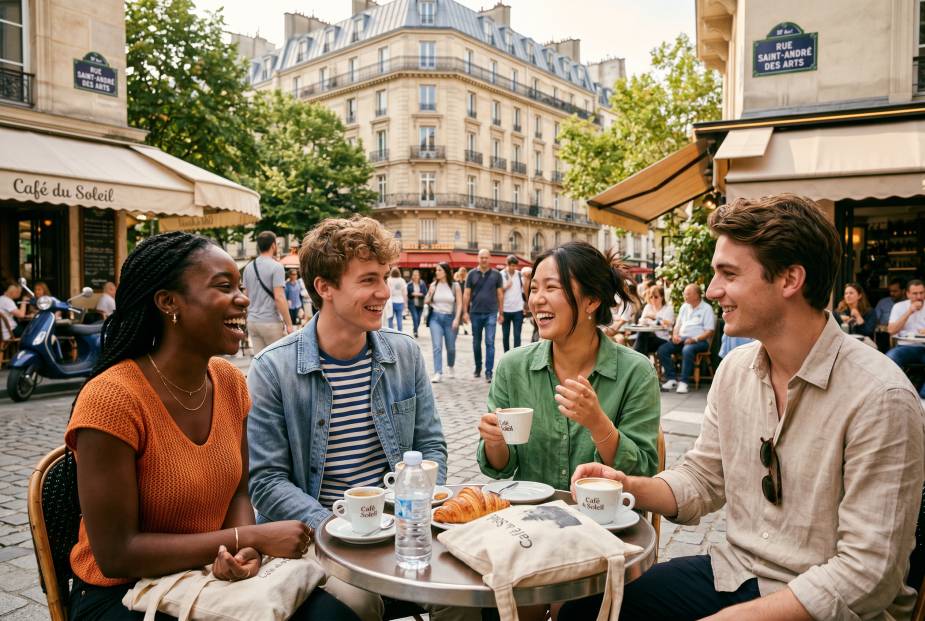
Social life is in full swing — international fairs, wine-and-cheese evenings, flag parties. Associations such as the Erasmus Student Network put on boat parties on the Seine, Latin American dance nights and language cafes. You will not be bored.
Transport is an art form in its own right. Trains, the metro and buses run with minute-by-minute precision. Students get discounted travel passes, and sometimes the semester fee already covers free travel around the region.
What you will not find anywhere else
The French take hierarchy seriously. It is customary to address professors and administrators by their full titles — «Monsieur le Professeur». They are also direct, and can seem a touch brusque until you get used to it.
The Grandes écoles — already mentioned — are a universe of their own. Their graduates dominate the business elite, the civil service and academia.
CROUS is a state system that gives students cheap housing (200–600 euros), meals for 1 euro, sport, culture and healthcare. In many countries no such thing exists.
And one more guiding principle: the balance between study and life. Working hours are strictly limited, and constantly checking your work email after hours is simply not done. The French have mastered this.
What matters for Kyrgyzstanis
Scholarship programmes are open to our compatriots. The Embassy of France in Kyrgyzstan offers a social scholarship that covers the cost of the visa. There is also a language-assistant programme — you spend a year teaching French in schools and colleges across the country, earning about 1,100 euros a month. You apply through Campus France and the embassy.
One important point: the Kyrgyz-European Faculty at Balasagyn KNU awards double diplomas with the University of Poitiers. You study in Bishkek, then spend a year or two in France, and come away with qualifications from both countries — which cuts the cost of the journey considerably.
The French embassy works closely with our universities and holds conferences on studying in France. Do not hesitate to get in touch.
In short
France is no longer the budget option it was a couple of years ago. But it remains a country with a powerful education system and a unique culture. If you are ready to pay almost three thousand euros a year for a Bachelor’s, to learn to navigate the bureaucracy, to reach a B2–C1 level in French and to live in a country that prizes discipline and formality, a French degree will be your ticket to the international job market.
If you still have questions — choosing a university, preparing for the Grandes écoles or finding scholarships — come and talk to our specialists. We will help you map out the route without the unnecessary stress.