Education in Turkey
Turkey is a country of contradictions. The low prices draw you in, the bureaucracy wears you down; the warm welcome delights, while the uneven standard of its universities gives you pause. In all honesty, Turkey has become one of the region's leading study destinations in recent years: nearly 350,000 international students from two hundred countries now study there. And for us Kyrgyz, there is a further bonus — Turkey is perhaps the shortest route to a European diploma without the jarring "us-and-them" divide. Let's work through it calmly, point by point.

The good and the not-so-good
Let's start with the immediate appeal. Tuition fees here are so low that any European or American would do a double-take. At state universities, a Bachelor's taught in Turkish costs from 1,200 to 6,000 dollars per year depending on the subject. In English it costs more — from 2,500 to 12,000, with medicine traditionally at the top. Private universities are pricier, of course — from 4,000 to 20,000 dollars — but they often award their own scholarships. Accommodation is another pleasant surprise: even in Istanbul you can keep within 450–650 euros per month, including rent and food.
Turkey issues internationally recognised diplomas. A couple of local universities appear in the top 500 of the QS and THE 2026 world rankings — the Middle East Technical University and Koç University, for example. Several more sit in the 501–600 band. And in Istanbul alone, more than fifty universities offer programmes in English, particularly in the private sector.
And the main draw — scholarships. The government's Türkiye Bursları programme covers everything: tuition, a monthly stipend, accommodation, insurance and even airfare. Applications from Kyrgyz citizens are accepted for Bachelor's, Master's and doctoral study.
But there is a flip side. The standard of education swings like a pendulum. Alongside world leaders sit fly-by-night universities whose diploma is best kept away from an employer. Students put it bluntly on the forums: «the teachers approach it very carelessly, just so everyone passes». That happens too.
Bureaucracy is a sport in its own right. A residence permit (ikamet) can take months to arrange — your nerves won't hold out. And from 1 January 2026, international students have partly lost access to the state SGK medical insurance — you now have to provide financial guarantees to obtain it. Then there is the language barrier: even if you study in English, you'll be lost in daily life without Turkish.
What programmes are available
For school and university students who want to test the water first, there are language camps and summer schools. The prices are reasonable and the immersion is total — a good first step.
Secondary education at private schools and boarding schools is the route for those who want a Turkish school certificate. A year at a private boarding school can cost from 5,000 to 40,000 dollars depending on prestige, though many good schools fit within 15,000–25,000. Not cheap, but not the Swiss 130,000 either.
A Bachelor's is the main route. Medicine at state universities runs to 3,000–8,000 dollars per year, and 15,000–27,000 at private ones. Engineering is noticeably cheaper: 500–2,000 at state universities and 5,000–10,000 at private ones. And economics and management programmes at state universities are simply a steal — just 300–1,000 dollars per year. To enrol on an English-language programme, you need a TOEFL of 70 or an IELTS of 6.0.
Master's and PhD — here there are plenty of English-language programmes, especially at doctoral level. A year of a Master's at private universities costs from 10,000 to 28,000 dollars; at state ones, a laughable 400–1,000.
An MBA — for career goals. Turkish business schools, particularly those attached to private universities, deliver a quality education at prices well below European ones: from 10,000 to 28,000 dollars per year.
What student life is like
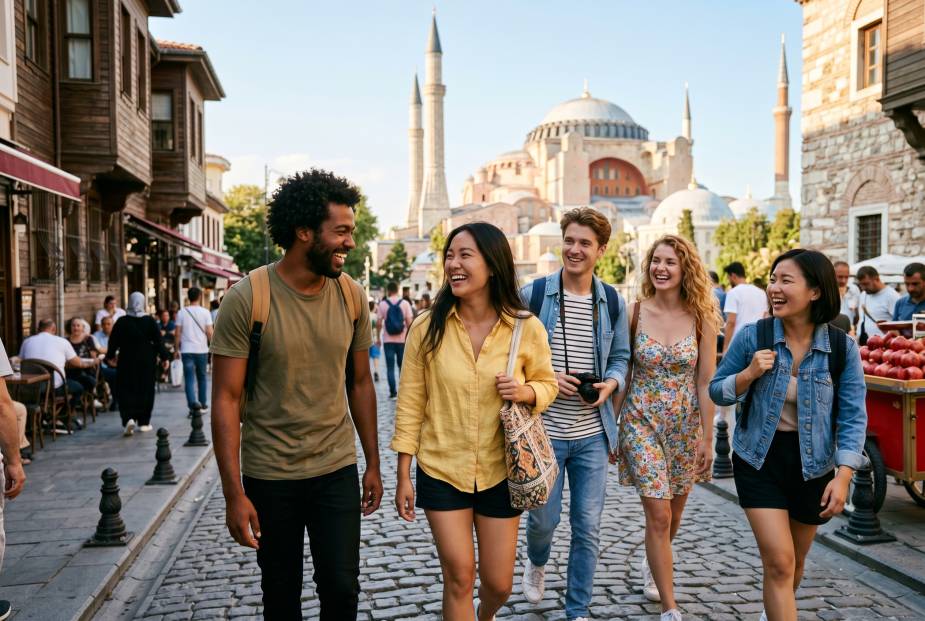
Life in Turkey balances Eastern hospitality with a Western pace. Istanbul brims with chaotic energy, while Ankara and Izmir are altogether calmer.
The main headache is housing. State student halls (KYK) are the most affordable at just 15–30 euros per month, but there aren't enough places to go round. Rooms in private halls cost 100–350 euros. You can rent a flat or a room for 150–400 dollars. We'd advise young women to look at the TÜRGEV women's halls — they offer round-the-clock security and good conditions.
Food comes to about 100–200 dollars per month if you cook for yourself or eat in the university canteen. The local cuisine is a reason to come in its own right: cheap, hearty and wonderfully tasty. Transport is excellent — metro, trams, buses and ferries. A student travel card gives a discount, and in Istanbul, with an IstanbulKart, you can cross the strait and move between Europe and Asia.
What you won't find anywhere else
The Türkiye Bursları programme is not merely a scholarship but full support: a year of a free language course up to C1, a place in a hall of residence, monthly payments and cultural events. A genuine golden ticket.
And, of course, a gentle transition. Turkey is a bridge between Asia and Europe, and a Kyrgyz student settles in more easily here than in Germany or the USA: the mentality is closer, the language barrier less daunting at the outset, and the welcome is warm.
The strengths of Turkish education are medicine and engineering. The Middle East Technical University is renowned for its engineering programmes, and the medical schools of Istanbul and Ankara provide solid training.

What matters for Kyrgyz citizens
The main opportunity is the Türkiye Bursları programme. Turkey's Ministry of Education sets aside quotas for Kyrgyz citizens every year for Bachelor's, Master's and doctoral study. Applications are usually accepted from January through February on the official website turkiyeburslari.gov.tr. What does the scholarship cover? Everything: tuition, a monthly stipend, free accommodation, medical insurance and return airfare. It also grants a year of free Turkish-language study for those who fall short of the required level.
Requirements: for a Bachelor's you need a school certificate with good grades and a pass in the YÖS exam (for foreigners) or a high SAT score. For a Master's — a Bachelor's diploma and a command of English (TOEFL or IELTS).
On top of that, Kyrgyz-Turkish universities such as the International University of Kyrgyzstan have direct agreements with Turkish universities, which simplifies transfers and the recognition of credits.
The main points in brief
Turkey is a country where, for a moderate sum, you can earn a perfectly decent European education and live in a culture close to us in spirit. You can study for 300 dollars a year, eat for 100 dollars a month and, in your free time, travel across two continents. But be ready for bureaucratic delays and for the wide variation in university quality. Choose wisely.
If you'd like to work out which Turkish university is right for you, how to apply for Türkiye Bursları or how to prepare for the YÖS exam — speak to our specialists. We'll help you shape a strategy and make the path to a Turkish diploma clear and predictable.